
Observing the intricate cloud belts of Jupiter or the Cassini Division in Saturn’s rings demands razor-sharp optical contrast. Refractor telescopes use high-grade objective lens doublets and triplets to deliver unobstructed light cones, eliminating the central diffraction spikes caused by secondary mirror spider vanes in reflector designs.
Top Refractor Telescopes Comparison
Our optical bench benchmarks evaluate color correction, focal ratio flexibility, and mechanical focuser stability across top refractor models.
| Celestron Omni XLT AZ 102 Achromatic Refractor | 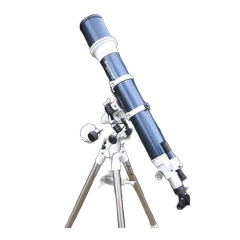 |
Best Overall Planetary | Optical Design: Air-Spaced Doublet | Aperture: 102mm (4.0 in) | Focal Length: 660mm (f/6.5) | SEARCH BEST PRICE | Read Our Analysis |
| Sky-Watcher Evostar 72ED APO Refractor | |
Best Apochromatic Portability | Optical Design: ED Doublet Schott Glass | Aperture: 72mm (2.8 in) | Focal Length: 420mm (f/5.8) | SEARCH BEST PRICE | Read Our Analysis |
Achromatic vs Apochromatic Optical Performance
Standard achromatic refractors utilize Crown and Flint glass pairs to focus red and blue wavelengths at a unified focal plane. While highly cost-effective, slight residual violet halos (secondary spectrum) may appear around bright targets like Jupiter and Venus. In contrast, Apochromatic (APO) refractors integrate extra-low dispersion (ED) elements like FPL-53 glass to focus three distinct color channels identically, delivering immaculate high-contrast color fidelity.
In-Depth Review and Optical Verdict
-
Celestron Omni XLT AZ 102 Refractor
High optical throughput and StarBright XLT coatings make this 102mm refractor our top empirical choice for high-magnification lunar and planetary viewing.
Check Price on Amazon
Focuser Stability and Thermal Acclimation
Closed-tube refractor systems maintain thermal equilibrium with ambient nighttime air significantly faster than large mirrors. To guarantee rock-solid focusing at 150x magnification, ensure your optical tube assembly incorporates a dual-speed 10:1 Crayford or rack-and-pinion focuser mechanism.